
The latest escalation in tensions with Iran is already sending shockwaves through global energy markets. Oil prices are rising, gas prices are following, and uncertainty is spreading across supply chains and economies. As we follow the war and hope for a quick de-escalation, the pending energy crisis is an opportunity to reflect.
Events like this signal that it’s time to reassess our vulnerabilities and rethink what national security means. Even though the US has been a net energy exporter since 2019 , the prices we pay are influenced by global markets. About 20% of the world’s oil and liquefied natural gas (LNG) flows through the Strait of Hormuz, a narrow waterway bordering Iran that is critical to global energy supply. Disruptions in such a key region can quickly raise costs for households and businesses. Gasoline prices are the most obvious example, but the impact extends much further: As global LNG markets tighten, U.S. exporters become more active, which can drive up domestic natural gas prices. Rising uncertainty leads investors to rebalance their portfolios, triggering volatility in the stock market. This volatility, in turn, affects businesses’ access to capital, reduces confidence in future investments, and ultimately weakens consumer purchasing power, which is already tenuous.
Our economy, our livelihoods, and our way of life grounded in self-determination all depend on reliable, affordable energy. The relationship between energy and the American economy has been recognized for decades, particularly since the OPEC oil embargo of 1973-1974, when Americans stood on lines for hours to fill up their gas tanks. But that crisis triggered positive, transformative change: 1970s oil shocks led to major efficiency reforms that still form the backbone of energy savings today. Similarly, Russia’s prolonged attacks on Ukraine have forced a shift toward electrified systems powered by distributed renewable energy, creating an energy infrastructure that is better able to withstand military attacks and natural disasters.
Readiness Requires Stable, Affordable Energy
Like earthquakes in California, hurricanes in Florida, or winter storms anywhere along the east coast, volatility happens in energy markets. Preparation is key — and the U.S. can be far more prepared than we are today.
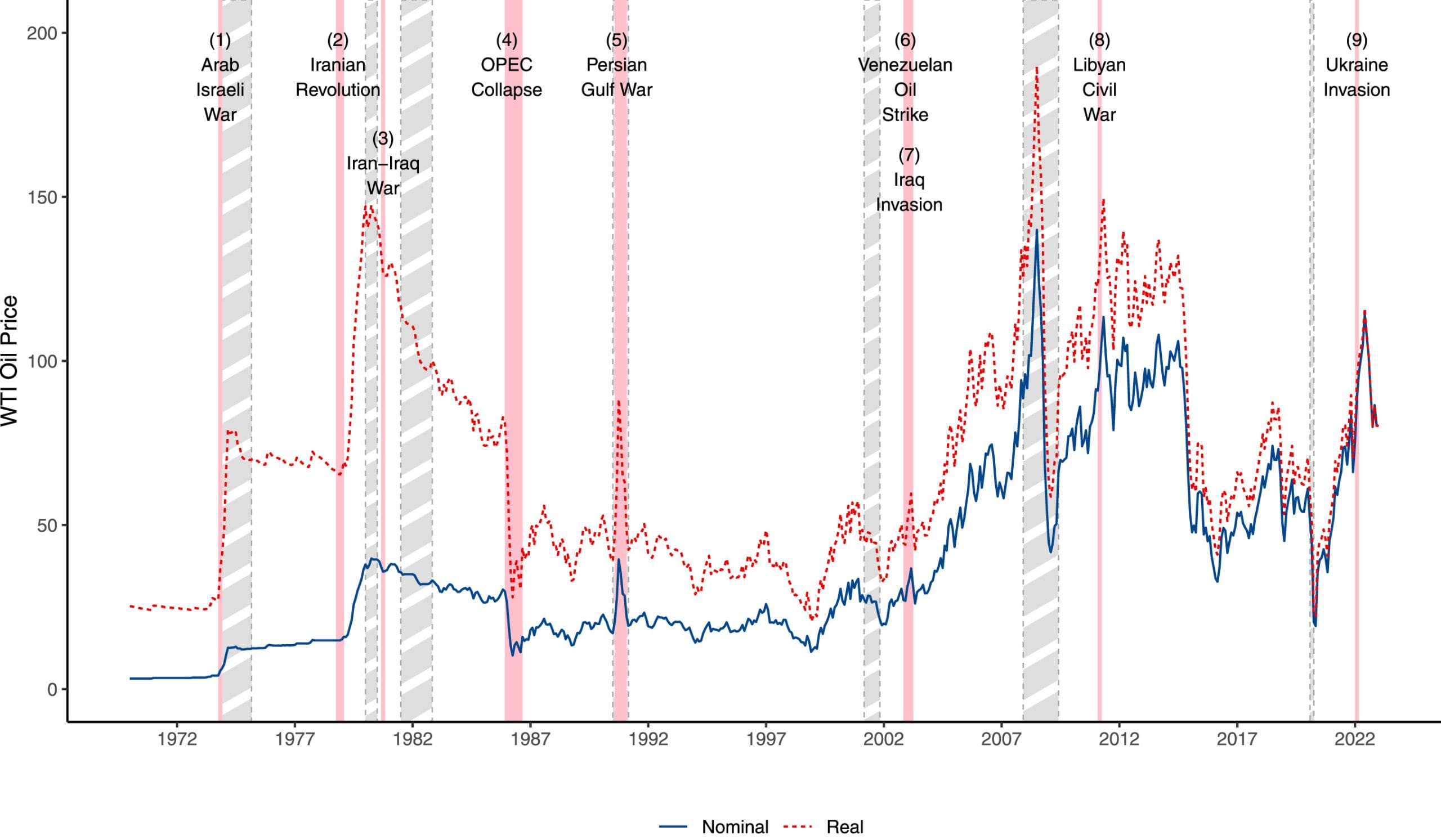
Oil prices over time, geopolitical events highlighted.
Credit: Knut Nygaard, Lars Qvigstad Sørensen. Betting on War? Oil prices, stock returns, and extreme geopolitical events. Energy Economics, Volume 136, 2024, 107659, ISSN 0140-9883, https://doi.org/10.1016/j.eneco.2024.107659.
As the U.S. economy becomes increasingly digital, the demand for a stable and affordable supply of energy continues to grow. Powering the data centers that support cloud computing and artificial intelligence has become a matter of national security.
The same is true for defense: many military operations today rely on advanced technologies and remotely operated systems. These capabilities require vast computing power and resilient energy infrastructure to function effectively. In this sense, energy and technology—and by extension, energy and national security—are inseparable.
We can hope for a conflict-free world, but, simply put, if we care about national security we need to care about energy security. Building resilience into our energy systems buffers us—from a national level down to a community level—against the ripple effects of crises that extend far beyond war zones.
Thankfully, we have multiple proven tools at our disposal: energy efficiency, distributed energy resources, and grid integration. All three of these strategies work together to create the powerful, reliable, and flexible energy systems that we need. This moment presents a clear opportunity for policymakers to rethink priorities and fulfill their responsibility to protect the public good.
The Path Forward: Energy Efficiency, Distributed Energy Resources, and Grid Integration
Energy efficiency is not just an economic or environmental strategy—it is a national security imperative. When energy prices are volatile, the fastest way to reduce impact isn’t to produce more, but to waste less and use energy more wisely. We don’t need to revisit the well-established evidence that measures like envelope insulation, efficient HVAC systems, and smart energy management can significantly reduce energy use without sacrificing comfort—or that these investments often pay for themselves. Those points are proven. What deserves renewed attention is this: we already have the tools and technologies to reduce our vulnerability.
Along with energy efficiency, distributed energy resources (DERs) are another cornerstone of energy. DERs are small-scale energy generation (such as photo-voltaic, small wind turbines, combined heat and power), storage (lithium batteries, electric vehicles), or management technologies (demand response and smart energy controls, waste heat recovery) located close to where energy is used. When DERs combine with energy efficiency and both resources are integrated into the grid, the whole is greater than the sum of the parts. Efficiency reduces the amount of energy needed, making DERs smaller, cheaper, and more effective.
The combination of energy efficiency and grid-integrated DERs has quietly and consistently supported GDP growth by providing affordable energy—the backbone of economic development. Amid high energy prices, energy efficiency—when done right—does not require sacrifice; it makes us more comfortable and gives us lower bills.
Public policy exists to ensure that, as a country, we take a long-term, forward-looking perspective. An example is the Strategic Petroleum Reserve (SPR), another cornerstone of our energy security—and therefore our national security and foreign policy. Although the SPR had been talked about for decades, the final trigger for its creation was the oil embargo of 1973-1974. Now, 50+ years later, the United States can take another decisive action with grid-integration of efficiency and DERs. An integrated approach is inherently local and predictable, shielding households, businesses, and the broader U.S. economy from global supply shocks and price spikes, and also ensuring that Americans can control their energy future rather than reacting to instability abroad. This approach does not depend solely on the federal government; it empowers state and local governments and communities to strengthen their own energy security and resilience. Community examples and proven cases can be found in California, Massachusetts, Texas, Iowa, Tennessee, Wisconsin and many other states, regardless of political affiliation, geography, or grid conditions. National security and community safety are interests we all share.
Efficiency and Resiliency Are Smart Consumer Choices, but They Are Also Necessities
Governments have a responsibility to protect people from exposure to volatile and unpredictable risks and costs. U.S. policymakers should invest in energy security with the same seriousness and commitment that they invest in the military because both are essential to our national defense.
At a time when many elected officials are campaigning on affordability, constituents should be asking: how—and how long will it last if achieved? Expanding access to lower-cost healthcare, housing, education, and transportation are all important. But those efforts are difficult to sustain if the underlying economic engine isn’t strong. Long-term affordability depends on lowering the cost of doing business and increasing certainty for investment, both of which drive job creation and stable tax revenue. Energy sits at the center of that equation.
For many businesses, energy is a significant operating cost. While cheaper fossil energy may seem like a solution in the short term, the real question is reliability. How stable is that supply? How predictable are those prices? What are the life-cycle-costs of running these systems? Faced with that choice, rational business owners and homeowners should choose a system that offers consistency over volatility, and long-term stability over short-term relief. Yes, that type of system is good for our climate, but it’s just as much about building an economy that is resilient, predictable, and able to withstand shocks, so that affordability is not just promised, but sustained.
A Strategic Moment for Action: Building for Stability and Security
Doubling down on energy efficiency and accelerating the integration of other behind-the-meter solutions and modern grid management are no-regrets strategies. They strengthen resilience, reduce exposure to price swings, and help buffer against exactly the kind of volatility we are seeing today.
In particular, NBI calls on state and local governments and elected officials to take action in the following areas:
- Adopt and strengthen building energy codes and standards to protect the public good. We need consistent policies that ensure continued progress—not rollbacks—in energy performance and efficiency.
- Expand supportive policies and incentives to upgrade existing buildings, with a focus on low- and moderate-income households, small businesses, and vulnerable communities. These investments are critical to ensuring equitable access to lower energy costs and improved resilience.
- Break down silos across programs and financing to accelerate technology adoption and capture multiple benefits. Better alignment across policy, funding, and implementation can unlock greater impact at scale.
- Actively support policies and projects that combine energy efficiency and locally– produced renewable energy with resiliency and health priorities to make the most of investments and tax dollars.
- Set requirements for economic development tax credits and other incentives so that projects must rely primarily on energy efficiency and renewable energy, to ensure that public dollars do not incentivize fossil fuel infrastructure investments and lock us into reliance on volatile commodities and unstable global markets.
NBI is actively working in all of these areas—advancing building codes and polices; lowering barriers to scalable, affordable building upgrades and technology deployments; and creating cross-sector alignment. Our role is to support policymakers and industrial leaders to unlock the power of buildings, to transform energy systems and improve lives.
We continue to seek allies and partnerships with like-minded organizations to leverage efforts, share expertise, and build coalitions to achieve more and faster together. We also support community groups and local advocates by providing technical assistance and trusted information so they can strengthen their communities. These organizations know their neighborhoods best—and we help turn that local knowledge into effective strategies and action.
Register for updates from NBI to stay tuned on upcoming resources and support to build a more secure energy future for everyone.
Author
 by Nora Wang Esram, CEO, New Buildings Institute