

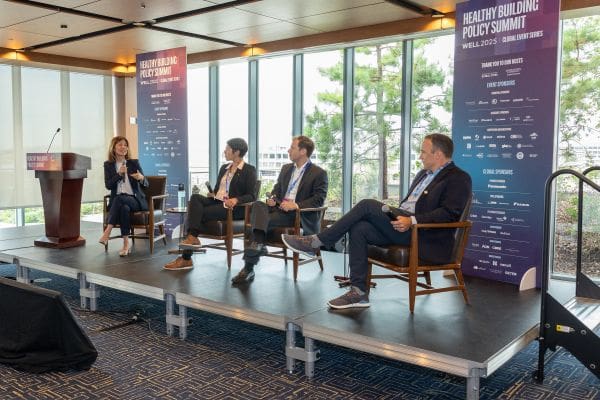
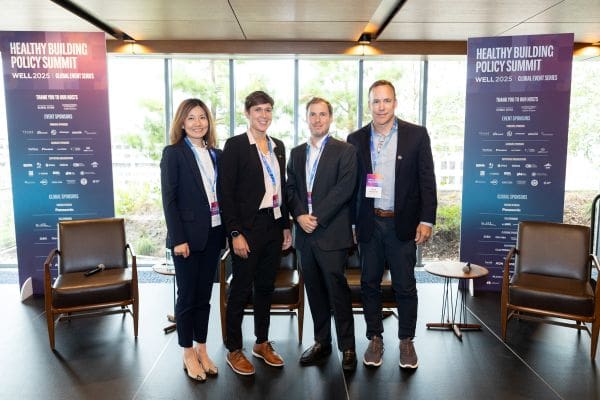
At the IWBI Healthy Building Policy Summit in Washington, DC, hosted by IWBI and Georgetown University, I had the privilege of having an in-depth conversation on healthy building policies with public health, building technology, and standards and certifications experts in a panel discussion titled, “A National Opportunity for Action: Unlocking Policy Solutions to Accelerate Healthy Indoor Air.”
Together, we explored how policy, technology, and industry action can accelerate progress toward healthier, more resilient buildings— for stronger, more productive people. As Dr. Richard Carmona, 17th Surgeon General of the United States, said in his opening remarks: “Optimized buildings lead to optimized people, which lead to optimized performance.” I am sharing my learnings from the panel discussion and the Summit in this blog post as one of our initial steps toward advancing the movement for healthy indoor air.
Making the Invisible, Visible
Everyone cares about their personal health. Social media and news headlines are dominated by information on how food, exercise, or medicine affects our health. Indoor air quality (IAQ), by contrast, is invisible. Its impact is subtle but constant. We don’t notice it until something goes wrong. The COVID-19 pandemic brought IAQ into focus, and we scrambled as we realized we weren’t prepared to safeguard the air inside our buildings. Now, as the pandemic fades in the rearview mirror, the public is starting to forget why the quality of the air we breathe matters so deeply. The challenge is: how do we keep IAQ top of mind without waiting for another crisis?
Dr. Georgia Lagoudas, Senior Fellow, Brown University School of Public Health and former Senior Advisor at the White House Office of Science and Technology Policy emphasized that progress requires action at four levels: policy, technology, society, and the market. That mirrors NBI’s approach to market transformation: developing policies that send signals to the market, testing technology and funding mechanisms to support implementation, building user awareness to drive demand, and cultivating leadership and capacity to deliver solutions. Dr. Lagoudas highlighted the Global Commission on Healthy Indoor Air launched at the United Nations during Climate Week to raise awareness and build global momentum.
How do we begin conversations when the priority is not public health or healthy buildings? Dr. Lagoudas and Jonathan Gritz, SVP of Energy Solutions, WellStat, both shared how they had made IAQ visible. During a legislative session, Dr. Lagoudas brought a handheld particulate matter (PM) monitor. As more people entered the room, the PM levels spiked. When she demonstrated in real time that each person was inhaling 4% of the air exhaled by others, the discomfort was immediate—and so was the willingness to act. Mr. Gritz noted that in real estate, tenant complaints during lease renewals are often tied to air quality, along with thermal discomfort. Stuffy, smelly air isn’t invisible to tenants. If IAQ metrics (CO₂, PM, VOCs) are measured and displayed, tenants can demand change, and operators will have clearer paths for action.
NBI’s work to improve IAQ in schools began nearly a decade ago. We offer a “one-stop shop” for technical assistance and capacity support for energy efficiency, electrification, resiliency, safety, and health to U.S. school districts. NBI leads several national programs for schools, including the Energy CLASS Prize and the Efficient and Healthy Schools Program.
K-12 school buildings suffer from aging infrastructure, deferred maintenance, and a cumulative lack of investment. Students, teachers, and staff experience poor air quality and unhealthy, unsafe spaces, while budget deficits and escalating costs from maintenance needs and high energy bills plague administrators. Students in these schools experience reduced cognitive function , poor academic performance, absenteeism, and higher rates of respiratory illness and disease spread. As Congressman Tonko reminded everyone at the Summit, “For our country to be competitive, we need to invest in our next generation, and we need to make sure students are not harmed in their schools.”
Inefficiencies in the planning process can misdirect schools’ limited funding. For example, during the pandemic, many school districts purchased air purifiers for classrooms, but many of these are currently unused due to a lack of funding for maintenance and insufficient staff capacity. Additional funding to build capacity and to support annual IAQ audits in schools, as suggested by Dr. Lagoudas, would be a first step towards empowering school districts and staff to improve air quality in their buildings.
From Elite Buildings to Everyday Buildings
As IAQ becomes more visible and tools empower people to demand change, the next question is: are we ready to make higher IAQ standards mainstream? Many buildings—WELL-certified, LEED-certified, or aligned with other high-performance building standards—have demonstrated what’s possible. But they remain a small fraction of the market, often seen as “affluent” projects. Healthy indoor air is not a luxury—it’s a basic human right. Yet for economic reasons, we’ve deprived too many people of it.
Mr. Gritz shared that many buildings can significantly reduce energy use and improve IAQ without major upgrades. Low-cost control measures and optimized systems can yield energy savings of 10–30% while addressing tenant complaints. He noted that the building sector spends millions of dollars to fine-tune indoor temperature and humidity, so why shouldn’t we also consider better air quality? Basic rule-based controls may seem dull, but they are effective. With our existing knowledge and technology, scaling improvements to all buildings is possible if supported by policies and incentives.
Sean McCrady, VP, Software and Advisory, UL Solutions, emphasized that policy adoption is the key lever. Once IAQ standards are embedded into codes, they shift from “nice-to-have” to “must-have.” He uses the analogy of seatbelts. For decades, people didn’t buckle up, even though evidence showed seatbelts saved lives. It became common practice only when state seat laws were enacted in the 1980s. IAQ may follow the same path.
Rachel Hodgdon, IWBI’s President and CEO, echoed this during her fireside chat with Congressman Paul Tonko, who reintroduced the Indoor Air Quality and Healthy Schools Act. She asked: “Why do we need to keep proving the economic return of healthy buildings over and over again?” as she referenced the recently published “Investing in Health Pays Back: The Business Case for Healthy Buildings and Healthy Organizations,” the largest collection of research to date that links investments in health and well-being to measurable economic returns. The data is already there—it’s time to ensure that everyone benefits, especially vulnerable populations like children in schools, families in affordable housing, and seniors in assisted living.
Many speakers at the summit shared heartbreaking personal stories about their family members who suffer from asthma, heart disease, or allergies after long-term exposure to poor IAQ in rental apartments or schools, often unaware of the cause at the time.
Tackling the Perceived Barriers
We didn’t shy away from the hard questions and talked through several real-world challenges.
- Energy costs: bringing in more fresh air often requires additional heating, cooling, or dehumidification, which drives up expenses
- Split incentives: when tenants pay utilities, landlords have little motivation to upgrade buildings for efficiency. Improving IAQ and productivity is even tougher since tenants reap the benefits while owners bear the costs
- Legacy buildings: it is perceived that many older HVAC systems weren’t designed to handle higher ventilation loads
- Outdoor air quality: depending on season or location, outside air itself may not be healthy
Mr. McCrady emphasized the need to demystify the relationship between energy use and IAQ. When done properly, improving air quality doesn’t have to increase energy consumption. In fact, tightening leaky buildings can lower energy use while also boosting IAQ. At the Summit, Trisha Miller, VP of Aeroseal, shared an example from a recent project in New York: a multifamily property had installed new rooftop fans with state incentives, but the new system didn’t function properly due to leaking ducts and low static pressure. Once the building was properly sealed, the HVAC system finally worked as designed, energy use dropped, and IAQ improved. Ms. Miller said, “At Aeroseal, we’ve seen firsthand how ventilation and air sealing improvements in rehabilitation can completely transform building performance. It’s a constant reminder that many of the biggest IAQ and carbon gains come not from new equipment, but from fixing what’s already there.” Mr. Gritz added that many older buildings can outperform newer ones in terms of air quality when properly maintained and managed.
Mr. Gritz and Mr. McCrady had a small disagreement about whether dampers should be kept open or closed when outdoor air quality is poor. Mr. McCrady shared an example from a film shoot in Beijing, where the crew used plywood to block outdoor air intake due to concerns of outdoor pollution, but still suffered from high indoor PM. When the plywood was replaced with proper filters, the PM dropped dramatically. Mr. Gritz, on the other hand, found that closing dampers during wildfire seasons quickly reduced indoor PM levels. Despite different approaches, both agreed on one critical point: it’s essential to monitor both indoor and outdoor air, and to keep the right amount of air moving through filtration systems so indoor environments remain healthier than what’s outside.
From Insight to Action
The conversation ended with a focus on action. We shouldn’t wait for another pandemic to remind us of what’s at stake. Just as seat belt use became standard, so too must healthy air standards.
Many school districts are in urgent need of support yet face ongoing reductions in funding. Protecting our children should not be viewed through a partisan lens. We need robust policies that establish safeguards for the well-being of our children and provide adequate funding and support to school districts to improve the health and safety of their buildings.
As the saying goes, “we cannot manage what we don’t measure.” Mr. Gritz suggested tenants ask their landlords to measure air quality, noting that transparency drives accountability. Mr. McCrady added that monitoring must always be paired with actionable solutions. The supporting standards, technologies, and services are needed to enable effective market adoption. As we strive for healthier indoor air supported by technology and policy, industries have a crucial role to play. They can transform IAQ from an afterthought into a baseline expectation through innovative products and services. As a member of IWBI, Daikin Applied has incorporated healthy building principles in its product design. As Ms. Hodgdon put it, “the biggest challenge for healthy buildings in the market is the status quo.”
NBI has joined the newly created Global Commission on Healthy Indoor Air, bringing expertise to align IAQ with energy efficiency, resilience, and decarbonization. Communities shouldn’t have to choose between these improvements to the buildings where they live, work, and learn. As we look ahead, the next steps are clear: healthy indoor air is not optional; it is essential for health, productivity, and equity. We have the tools and technologies to make IAQ a baseline expectation in every building. We need supportive policies, increased implementation of innovative technologies, and industry action. As Dr. Carmona put it, “When people ask how we can afford to invest in healthy buildings, the real question is: how can we afford not to?”
Author
 by Nora Wang Esram, CEO, New Buildings Institute