This year, we moved our family into a 1924 bungalow. Moving is always difficult, but it felt particularly challenging because we needed to downsize, maximize usable space, and make updates. I thought about priorities for safety and resilience, both in the short- and long-term. We made our plans to upgrade home appliances to efficient models and remove fossil fuels from our home.
This is the story of what we learned, the challenges we encountered along the way, what worked, and recommendations based on our experiences.
Safety First
We live in Oregon, and like the rest of the world, we’ve been experiencing significantly higher temperatures. When we purchased our first home in 1999, we managed quite well without air conditioning—even in the attic bedroom. Unlike then, homes in this region now need cooling systems for health and safety. Our upstairs bedroom and office have felt like a sauna with more summer days reaching 90°F and higher.
When I was in college during the early 90s, I learned about how fossil fuels used by homes and buildings create greenhouse gases, which trap heat in our atmosphere, making our planet hotter. According to the U.S. Energy Information Administration, the three largest categories of residential electricity consumption in 2020 were space heating, water heating, and air conditioning, in that order. Tackling these three end-uses with efficient appliances run by electricity can be a part of solving this climate crisis. We wanted to make our home more comfortable while improving energy efficiency, reducing our emissions, and decreasing long-term costs.
Through extensive research, I found that new energy-efficient appliances like heat pumps and heat pump water heaters (HPWH) not only improve comfort, but they also add value in other ways. Heat pumps can avoid emissions since they run on electricity, not fossil fuels. HPWHs for example, transfer heat from the air into water rather than generating heat directly, so they are significantly more energy efficient. According to ENERGY STAR®, HPWHs can save a household of four approximately $550 per year on its electric bills compared to a standard electric water heater and more than $5,610 over the HPWH’s lifetime. They can provide emergency backup water and feature smart technology that better supports the electrical grid by reducing energy demand and optimizing time-of-use energy consumption. So, I gathered information on replacing our gas instant water heater and furnace with heat pumps.

Because we live in the Cascadia Subduction Zone, I also thought about ways to improve our safety in case of an earthquake. Not only is there a risk of buildings collapsing, but there is also potential for fires following an earthquake due to gas line ruptures.
I hoped to attach our house to its foundation as a safety measure but learned that the aging basement walls were not strong enough to withstand movement due to strong seismic activity. That took our plan in a new direction. We met with a foundation repair company and decided to install a reinforcement system. The system transfers the load from the failing foundation walls to an internal engineered structure. It was an added expense but, on the bright side, the work also adds waterproofing, insulation, and the possibility of additional living space. It’s also much more cost-effective to do work before there’s an emergency.
Managing Expenses & Getting Work Done
In order to install the system to reinforce the foundation, we would need to pull all plumbing and electrical work away from the walls. I did my research in advance and had already begun conversations with plumbing, electrical, and HVAC professionals. This holistic planning made it faster and easier to get started.
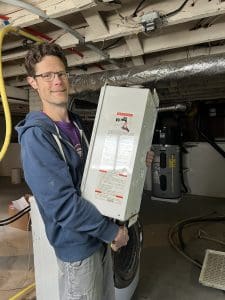 Like most people, we need to manage expenses and look for ways to reduce initial costs. We think about how to manage all of our expenses, including having two children in college now. We decided we could do part of the work to reduce costs. My husband removed the gas instant water heating system. This DIY task saved us the cost of deconstruction. We hired local contractors specializing in heat pumps and HPWHs to install heat pumps to efficiently meet our space conditioning and water heating needs. They quickly responded to our questions, making for a good overall experience. I can now breathe easier knowing that the air inside and around my home is cleaner without onsite gas combustion.
DIY Heat Pump Water Heater Installation
As I explored the possibility of handling some of the work ourselves, I felt good knowing that there were a lot of people who are doing installation work themselves and that there are resources to help.
One thing to note is that the installation costs of a HPWH are more than the equipment itself. A recent study, “Residential Heat Pump Water Heater Cost Drivers and Opportunities for Compression,” determined that DIY installations provide an average 70% savings. That’s useful information to have.
If you need help deciding if you want to DIY or hire a professional contractor, check out the new CALNEXT fact sheets, available in English and Spanish. These resources can help you decide to DIY, hire a professional contractor, or a combination of both. Learn more in the CALNEXT “DIY Heat Pump Water Heater Installation and Market Study.”
Help with Costs
Okay, but back to the costs—We covered our costs by stacking funds. This included funds on hand, rebates, and loans. The Inflation Reduction Act of 2022 provided us with a $2,000 tax credit. This benefit is available until the end of 2025. The Energy Trust of Oregon provided us with instant rebates on equipment. We took out a 12-month, 0% loan to finance the heat pump HVAC system. Some utilities also have programs to help cover expenses. Check with your local utility to see what programs they offer.
Bumps on the Path
Like many home projects, there were some challenges along the way. The heat pump HVAC product we wanted was delayed, so we had to wait longer than we hoped. We tried to save a little money by ordering the previous generation HPWH and found that the noise level was different from what was expected. Refrigerant levels in the HVAC system needed to be recalibrated for optimum performance. We learned the importance of checking and cleaning our filters. We discovered that if work nearby creates dust, it’s necessary to put the HPWH in electric resistance mode temporarily until the dust subsides and then clean the filter. We communicated with our contractors throughout the process, who promptly helped us find solutions.
Outcomes & Recommendations
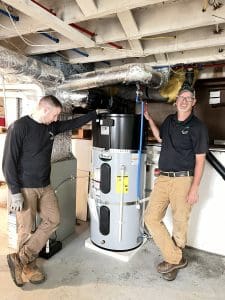
We are happy with our experience and now have more peace of mind. Our home is fully electric and has heat pumps for heating and cooling. Even with all the hot weather this past summer, the temperature inside our home is comfortable. We have reliable hot water, without the pollution of gas, and 61 gallons of emergency backup water stored in our tank, which we didn’t have before with an instant gas water heater. The cool air emitted as a byproduct from our HPWH creates a nice cellar-like space for storing wine and other cold-storage items. These updates benefit us in our day-to-day life and are steps in the right direction for resilience and reducing greenhouse gases.
My advice? Do your research early and have a holistic plan that connects the dots to improve comfort, energy efficiency, and resilience. I have some informative resources for you but be ready to make informed decisions before starting on a remodeling project and in case things take an unexpected turn.
It is interesting to learn about best practices for efficiency, and especially helpful to be informed before your existing appliances come to the end of their useful life. Consider short- and long-term costs, benefits, and goals. Enlist dependable help and stay engaged in the project to ask questions and provide guidance.
 Learn from informative resources and knowledgeable contractors about equipment performance, installation, and maintenance. Check out offerings from New Buildings Institute and the Advanced Water Heating Initiative, or email me at comms@newbuildings.org. You just started to connect the dots for resilience, comfort, and energy efficiency in your home!
Want to learn how you can get started with Heat Pump Water Heaters? Join the Advanced Water Heating Initiative (AWHI) for Heat Pump Water Heater Day and for special events and information releases that week. Check out the recorded installation videos with Great Northwest, which provide professional tips for smooth DIY installations.
AWHI’s Heat Pump Water Heater Day
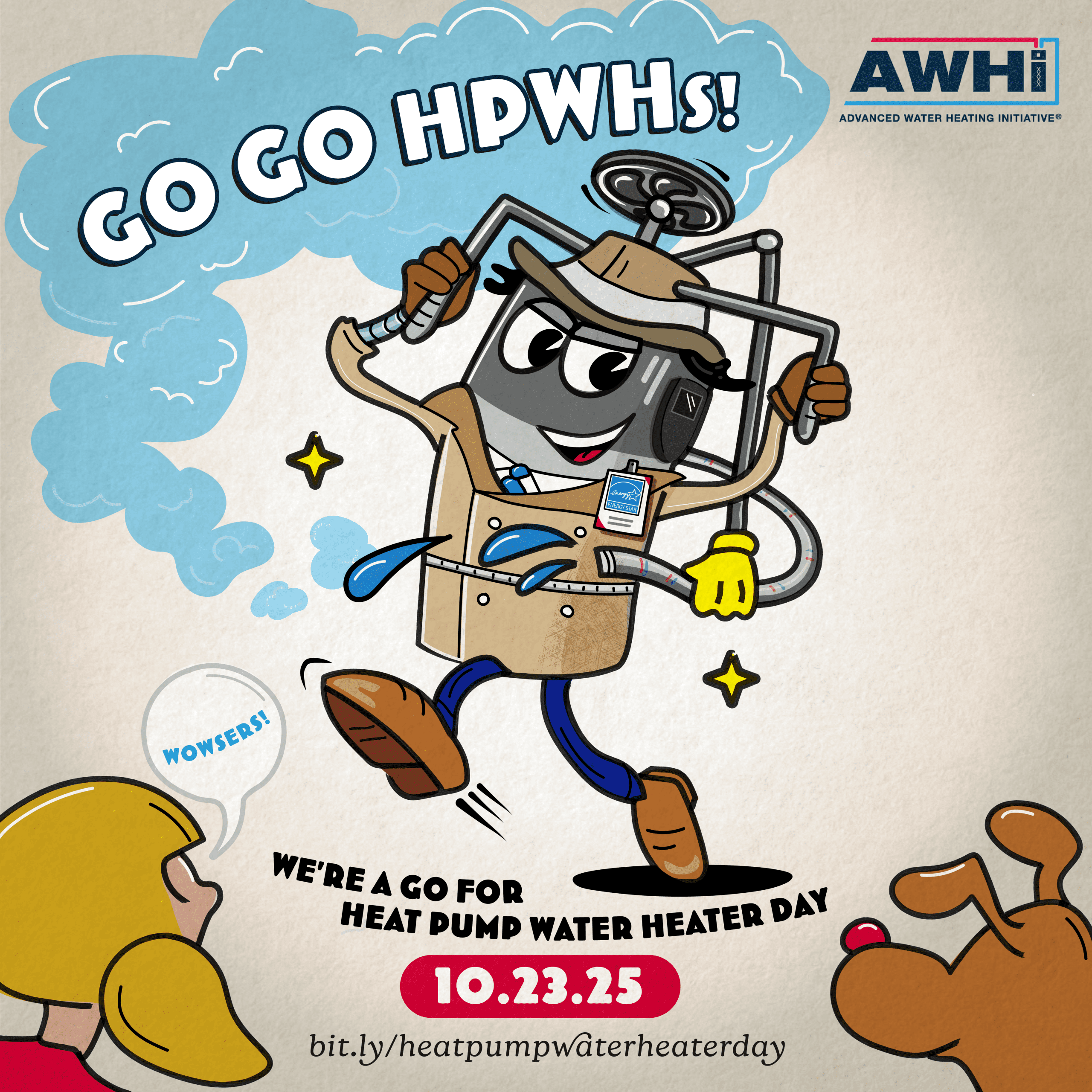
There were special activities on October 23, 2025 and throughout that week to provide fun and engaging information about HPWHs. Check out the related recordings and resources.
Author
By Susan Harris, Building Innovation Communications Manager